
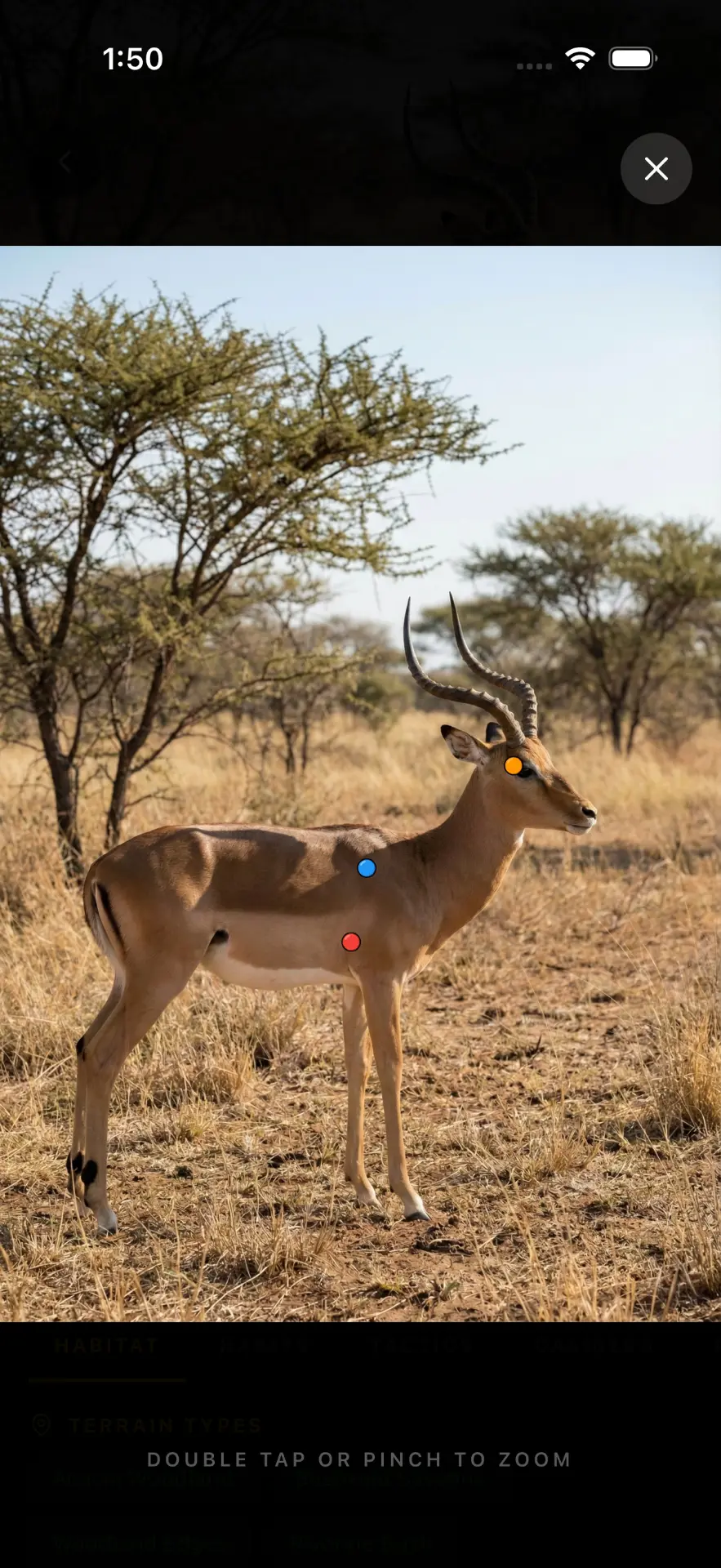
Broadside
On a leopard lying or standing on a bait branch, hold on the back line of the near front leg, a third to halfway up the body. The chest is only a little larger than a hand span on a big tom. Spots and shadows hide the anatomy, so look for the elbow.
Quartering and other angles
Quartering away, aim for the far front leg. Quartering to on a branch, aim at the point of the near shoulder. Leopards on a bait tree often feed facing the trunk; wait for the cat to turn broadside rather than shooting into the chest from the front.
Do not
Do not shoot a leopard you cannot see clearly, and never follow a wounded leopard without your professional hunter. A wounded leopard in cover is one of the most dangerous situations in African hunting.
Where they live and the typical miss
Found across Sub-Saharan Africa in riverine bush, rocky hills and thick cover. The typical miss is high, caused by excitement, poor light and a small target on a branch.
The last light
Toms often come to the bait at last light, or after dark where night hunting is legal. Practise shooting from a blind with a rifle rest in fading light, and know exactly where the tree is in your scope before the cat arrives.
Expanding bullets
Leopards are thin-skinned. Use a quick-expanding soft-point bullet for a large wound channel; a solid can pass straight through without enough effect.