Broadside
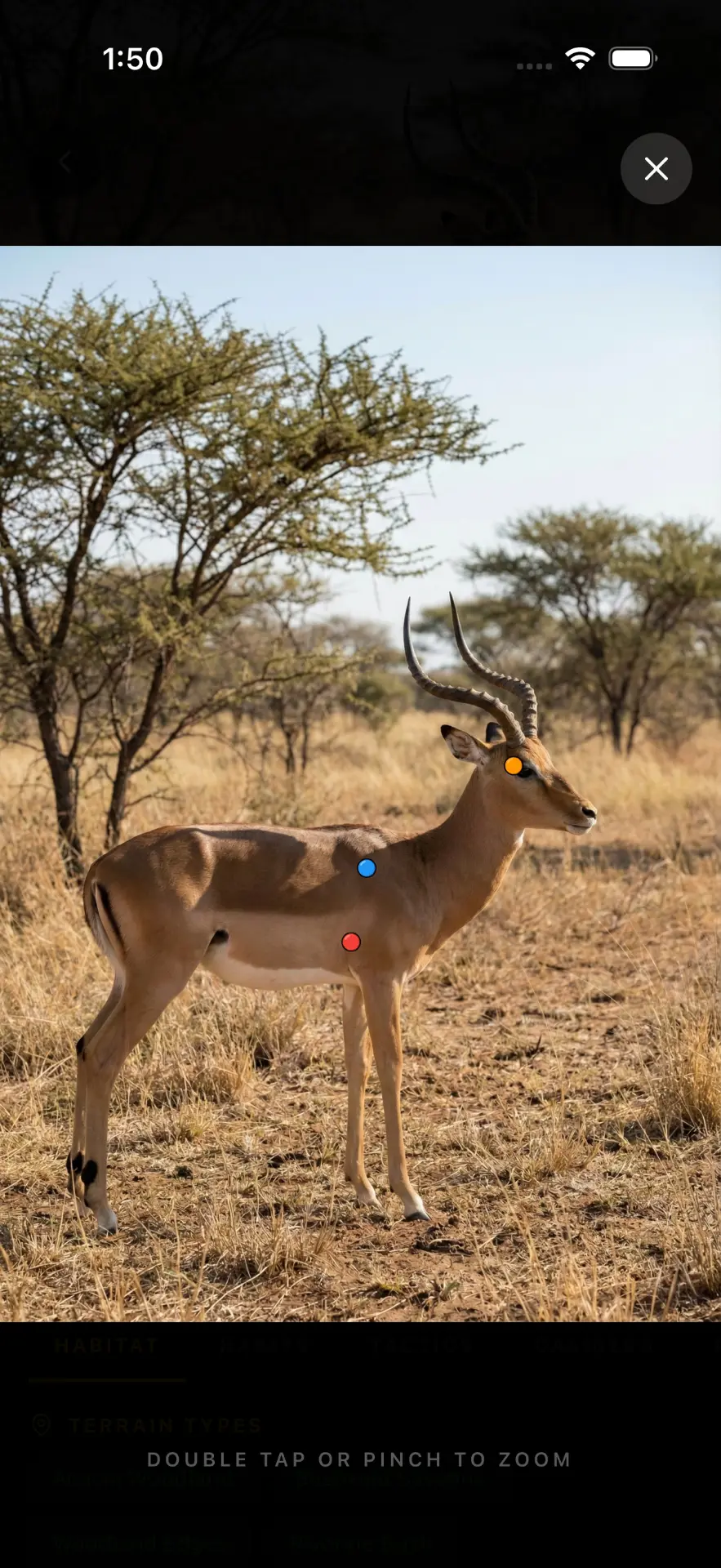
Hold on the back line of the near front leg, a third of the way up the body. A mature buck's thick grey winter coat and deep brisket make the body look bigger than the frame beneath; the heart sits just above the elbow.
Quartering and other angles
Quartering away, aim for the far front leg. Quartering to, enter at the point of the near shoulder with a bullet that will penetrate bone. On steep slopes, hold higher on the near side shooting downhill and lower shooting uphill, so the exit still comes through the far-side vitals.
Do not
Do not guess range in open country, and do not shoot at a stotting deer. Mule deer bound away on all four legs and often stop to look back; wait for the stop.
Where they live and the typical miss
Found across the western United States and Canada into northern Mexico, from sagebrush desert and prairie breaks to high alpine basins. The typical miss is high, caused by range misjudged across canyons and open slopes.
Open-country range
Mule deer are shot on open slopes where range is easy to misjudge. Use a rangefinder, and on steep uphill or downhill shots hold for the horizontal distance, which is shorter than the line-of-sight range.
The bounce
Spooked mule deer stot away and often stop to look back from the next rise. Be ready for the stop rather than shooting at a bounding deer.